Rethinking Education in the Age of AI
Educational institutions are often bound by rigid curricula, bureaucratic inertia, and a reluctance to deviate from established methods. This lag in adaptation leaves graduates ill-prepared for the rapidly changing job market.

TL;DR
The modern educational system faces a critical juncture with AI’s rise. While 86% of university students now use AI tools, we’re witnessing alarming trends: students submit AI-generated work they haven’t even read, can’t distinguish fact from AI hallucinations, and lose the ability to struggle through challenges. But this crisis also presents opportunity. Instead of banning these tools, we must revolutionize how we teach and test. Education should embrace visual learning, hands-on experimentation, and exams that mirror real-world conditions—with all tools available. We must transform from training chess pawns limited by rules to empowering chess queens who master the entire board.
Table of Contents
- The Origins of the Modern Educational System
- The AI Education Crisis: Problems We Must Face
- The Fundamental Question: Why Education?
- Solutions: Reimagining Education for the AI Era
- The Path Forward: Critical but Optimistic
- References
The Origins of the Modern Educational System
The modern educational system has its roots in the Industrial Revolution of the 18th and 19th centuries. Designed to meet the demands of an industrializing society, education was structured to produce a workforce capable of performing specialized tasks in factories and offices. This model emphasized standardization, conformity, and the compartmentalization of knowledge into distinct disciplines.
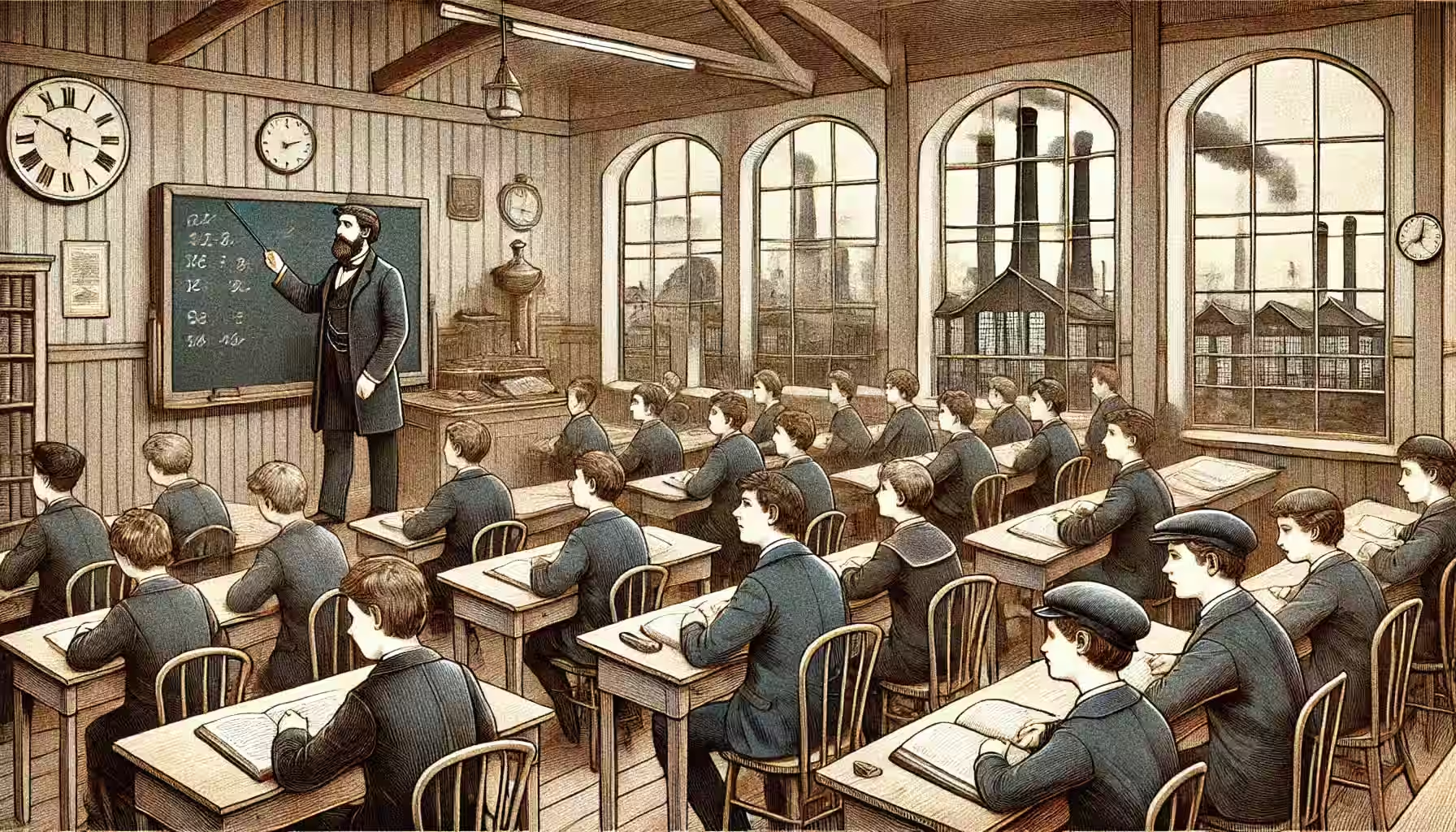
According to historian David Tyack in The One Best System: A History of American Urban Education (1974), the primary goal of education during this period was to create efficient workers who could fit into the hierarchical structures of industrial organizations. This system was effective for its time, producing generations of workers equipped with the skills necessary for industrial production.
The AI Education Crisis: Problems We Must Face
Today’s educational landscape reveals a troubling paradox. While AI democratizes access to information, it’s creating a generation of passive learners. Recent data shows that 86% of university students and nearly half of high school students regularly use AI tools, with concerning consequences.
The Three Core Problems
1. Not Using AI as a Learning Tool A Spanish teacher in Oklahoma discovered a student had submitted AI-generated homework—complete with the chatbot’s closing line: “I hope this is helpful to you.” The student couldn’t even read what they submitted. This isn’t learning; it’s outsourcing thinking entirely.
2. Not Reading What Is Generated 75% of students report they’ll continue using AI even if banned. But many submit AI work without reading it, missing errors, inappropriate content, or even obvious AI signatures. They’re becoming dependent on outputs they don’t understand. It’s like ordering food in a foreign language using Google Translate and being surprised when you get sheep’s eyeballs instead of the pasta you thought you ordered.
3. The Fact-Checking Crisis AI hallucinations are rampant. Students have written that “Moses got chocolate stains out of t-shirts” and cited non-existent sources. The White House’s Make America Healthy Again report contained AI-fabricated citations. If our highest institutions can’t fact-check AI, how can we expect students to? More critically—how do we even teach fact-checking in an era of convincing AI fabrications? It’s like teaching someone to spot fake designer bags when the counterfeits are made in the same factory as the originals.
The Deeper Crisis: Loss of Struggle and Grit
Perhaps most concerning is what one teacher observed: “The amount of time students are inclined to work on something that challenges them has become much shorter.” Students who once wrestled with concepts for days now give up within minutes, immediately turning to AI.
This isn’t just about academic performance—it’s about character formation. When we outsource struggle to AI, we lose:
- The confidence that comes from solving difficult problems (like the pride of finally assembling IKEA furniture without leftover pieces)
- The mental resilience built through persistence (the same grit that got you through Dark Souls)
- The deep understanding that only emerges through genuine effort (the difference between watching cooking shows and actually burning your first pancake)
- The ability to think critically when AI isn’t available (imagine your GPS dying in the middle of nowhere)
As Professor Robert Gell argues, using AI to complete assignments is “like going to the gym and asking a robot to lift weights for you.” But it’s worse—it’s more like using steroids. You get immediate results but become dependent, and when the enhancement is gone, you’re left weaker than before. Or like using an electric bike for the Tour de France—sure, you’ll finish first, but you’ll be disqualified and still can’t climb a flight of stairs without wheezing.
The Fundamental Question: Why Education?
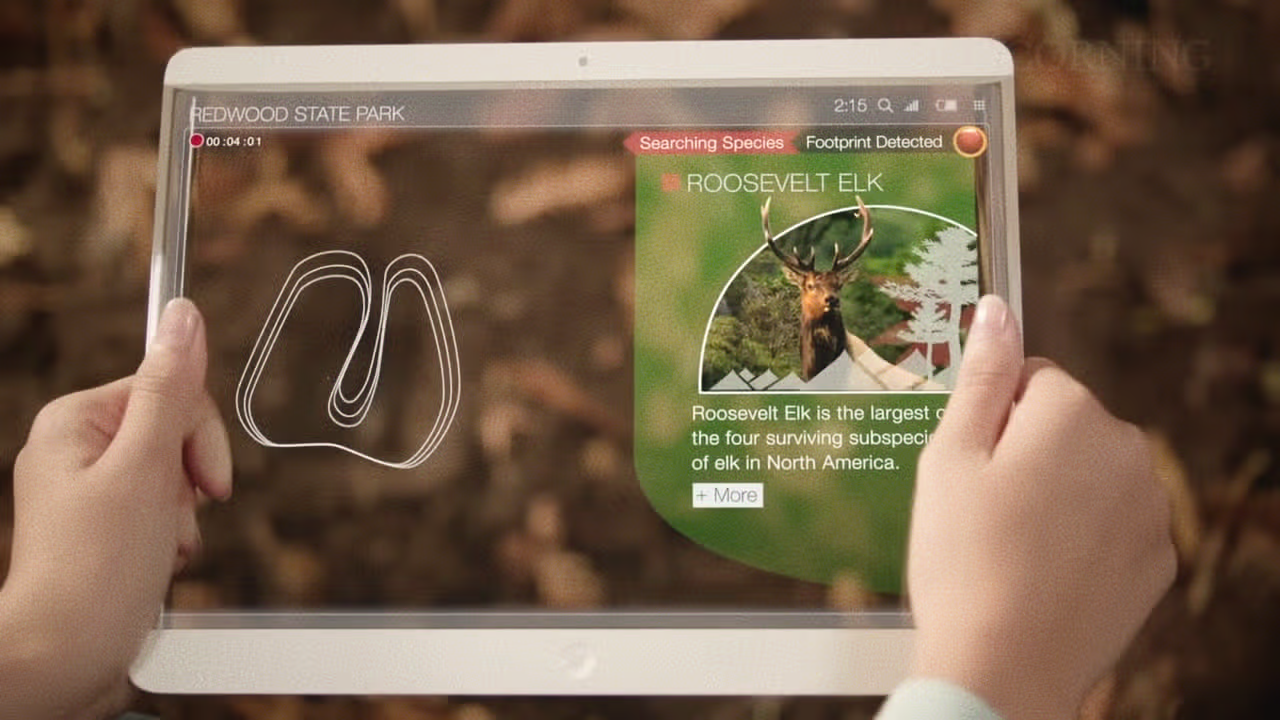
Before we dive into solutions, we must confront a fundamental question that AI forces us to ask: What is the point of being educated in the first place?
The current system, after elementary school, focuses primarily on building a career that will help you make money. The brutalist capitalism that created the modern school system shifted the motivation from learning and discovery to earning potential. Education became less about understanding the world and more about securing economic stability.
But here’s the problem AI presents: it’s changing the environment so dramatically and replacing skills so quickly that a career built over 16 years in a specific domain can literally be replaced in seconds. When AI can do in moments what took you decades to master, then what? It’s like spending years learning to be the world’s best telegraph operator, only to wake up one morning to find everyone’s using smartphones. Or mastering the art of VHS repair right as Netflix launches.
This isn’t just about job displacement—it’s about the entire premise of our education system. If we’re training students for careers that might not exist by the time they graduate, if we’re teaching skills that AI can replicate instantly, then we must radically rethink why we educate in the first place.
Perhaps the answer lies not in career preparation but in developing uniquely human capacities: creativity, ethical reasoning, emotional intelligence, and the ability to find meaning and purpose beyond economic productivity. The AI revolution forces us to return to education’s original purpose: creating thinking, adaptable humans, not just workers.
Solutions: Reimagining Education for the AI Era

The solution isn’t to ban AI—that ship has sailed. Instead, we must fundamentally reimagine how we teach and assess learning.
1. Learn by Doing, Not by Delegating
Critical thinking develops through active engagement, not passive consumption. Students must:
- Experiment actively: Build, test, fail, and iterate
- Record learning in their own words: Summarize concepts personally, not through AI
- Create visual representations: Sketching and diagramming cement understanding in ways text cannot
Visual note-taking is particularly powerful. When you sketch a concept, you must understand it deeply enough to represent it spatially. This process creates neural pathways that pure text reading cannot replicate. These visual notes become personal references you’ll never forget—and they’re uniquely yours, not AI-generated. It’s the difference between Instagram-stalking someone’s vacation and actually getting sand in your shoes at the beach. One gives you the pictures; the other gives you the experience.
2. Revolutionary Assessment: Test Like the Real World
Our current exam system is fundamentally broken. Why do we test students without access to tools they’ll use daily in their careers? It’s like “testing a football player without shoes, on mud, with blind eyes”—that’s not how they’ll actually play.
Instead, exams should:
-
- Allow all tools: Personal notes, computers, AI assistants (just like Batman doesn’t fight crime without his utility belt)
- Test synthesis and application: Can you use these tools to solve novel problems? (Like MacGyver with a smartphone)
- Evaluate critical thinking: Can you identify when AI is wrong? Can you improve its output? (Basically, can you be AI’s editor, not its copy-paste intern?)
- Measure creative problem-solving: Can you combine AI assistance with human insight? (Think Iron Man and JARVIS, not a ventriloquist and dummy)
Some educators are already adapting. Statistics professor Ben Pythri moved all writing assignments to in-class sessions, treating them like exams. This ensures students actually write and think, while still allowing them to use AI as a tool outside class.
3. Teaching AI Literacy and Critical Evaluation
We must teach students:
- How AI works: Understanding helps identify limitations
- When to use AI: As a collaborator, not a replacement for thinking
- How to fact-check: Cross-reference sources, verify citations, question plausible-sounding nonsense
- Ethical considerations: Academic integrity in the age of AI
Interestingly, a 2024 survey found that 65% of teachers who received comprehensive AI training reported increased passion for teaching. Training matters—for both educators and students.
The Chess Analogy Revisited
“The modern education system confines minds to rigid roles, converting them into chess pawns, while AI enables people to become chess queens. Education should be teaching how to play chess, not just piece movements.”
But here’s the critical addition: You can’t become a chess queen by having AI play for you. You become one by understanding the entire board, using AI as one tool among many, and maintaining the human capacities AI cannot replicate—creativity, empathy, ethical reasoning, and the ability to find meaning in struggle.
A Glimpse of What’s Possible
Some experimental schools are showing promise. They compress core subjects into two AI-assisted hours daily, then spend the rest of the day on life skills: solving Rubik’s cubes, assembling furniture, running a mile, learning juggling. Their standardized test scores remain in the 90th percentile, but students also develop grit, physical skills, and real-world competencies. It’s like learning to cook by both reading recipes AND actually setting off the smoke alarm a few times—you need both theory and practice.
This isn’t about replacing teachers with AI—it’s about using AI to enhance human potential while preserving what makes us human.
The Path Forward: Critical but Optimistic
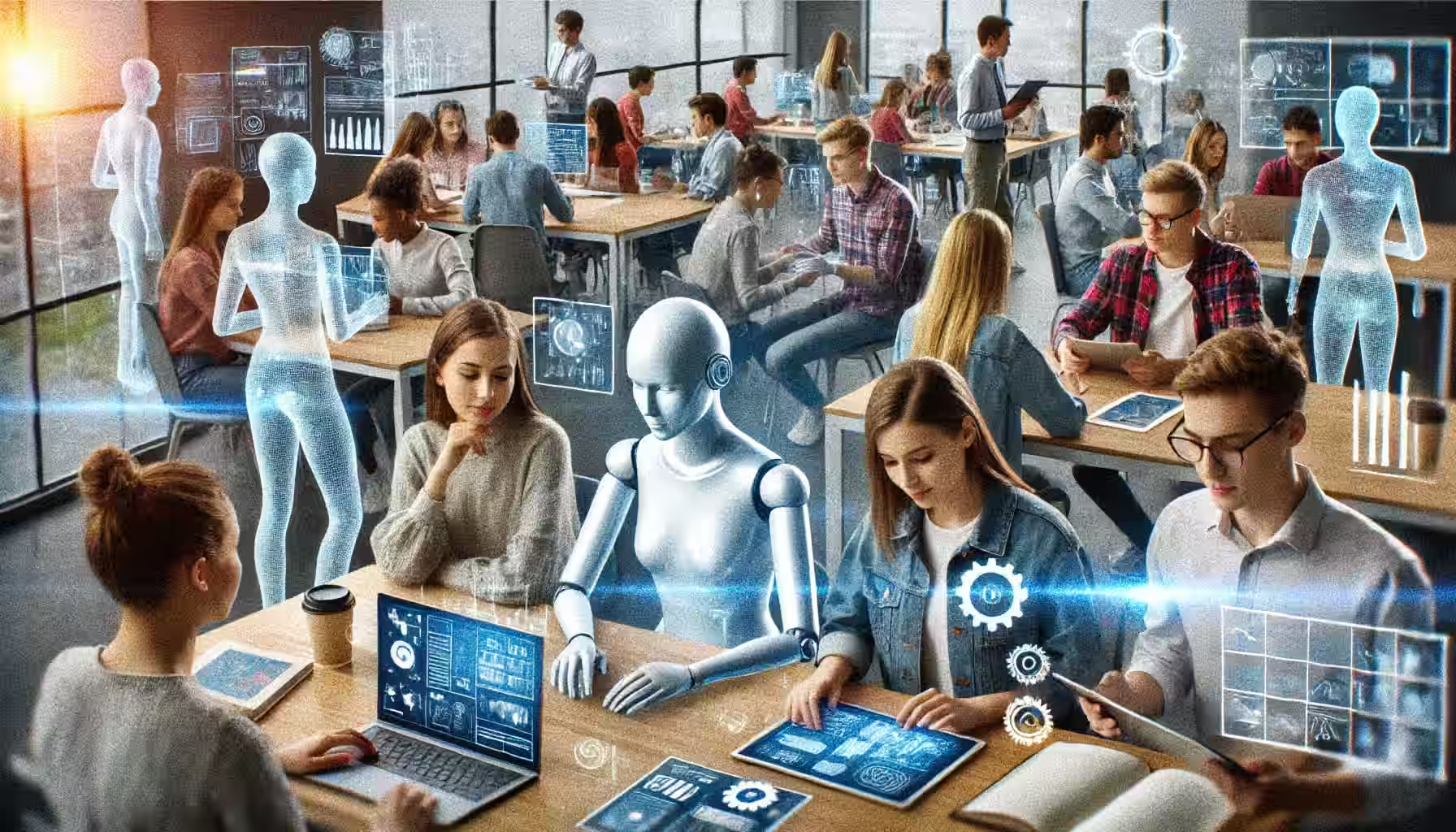
Yes, AI is creating an education crisis. Students are becoming passive consumers rather than active thinkers. They’re losing the ability to struggle, to fact-check, to deeply engage with material. The temptation to outsource thinking is overwhelming.
But crises create opportunities for transformation.
The comparison to calculators is instructive. When calculators emerged, many feared they’d destroy mathematical thinking. Instead, they freed us to tackle more complex problems. The key was learning when and how to use them appropriately. Nobody does long division at the grocery store anymore, but we still need to know if that “Buy 2 Get 1 Free” deal is actually saving us money or just making us buy more stuff we don’t need.
AI can follow a similar path—if we’re intentional. It can be:
- A thought partner that challenges our ideas (like a friend who actually read the book for book club)
- A research assistant that helps us find (and verify) information (think Hermione Granger, but in your pocket)
- A creative collaborator that expands our thinking (your brainstorming buddy who never judges your weird ideas)
- A personalized tutor available 24/7 (like having Yoda on speed dial, minus the backwards sentences)
But only if we maintain our human capacities: critical thinking, creativity, empathy, and the willingness to struggle.
The game is changing. We can either let AI reduce us to passive pawns, following its moves without understanding, or we can use it to become queens—versatile thinkers who leverage every tool while maintaining our essential humanity.
The choice is ours. But we must choose actively, critically, and soon. Because the students submitting AI homework they haven’t read today will be the leaders, doctors, and teachers of tomorrow.
And that future depends entirely on how we respond to this crisis today.

References
- Tyack, D. (1974). The One Best System: A History of American Urban Education. Harvard University Press.
- World Economic Forum. (2023). The Future of Jobs Report 2023. Retrieved from https://www.weforum.org/reports/the-future-of-jobs-report-2023
- Arum, R., & Roksa, J. (2011). Academically Adrift: Limited Learning on College Campuses. University of Chicago Press.
- Selwyn, N. (2019). Should robots replace teachers? AI and the future of education. British Journal of Educational Technology, 50(6), 1295–1300.
- Digital Education Council. (2024). AI Usage in Higher Education Survey.
- ACT. (2023). High School Student AI Usage Study.
- Turnitin. (2024). AI Writing Detection Analysis of 200 Million Papers.
- Study.com. (2024). Teacher AI Usage Survey.
- 404 Media. (2024). Teachers Are Not Okay. Retrieved from 404media.co
- “How AI is Ruining Education For Everyone”. (2025). YouTube. Retrieved from https://www.youtube.com/watch?v=GwEjuhpo26o